Appian Research Highlights UK Aloneware Costs
Aloneware research from Appian finds 79% of UK enterprise leaders allocate at least 10% of innovation funds to isolated AI software.
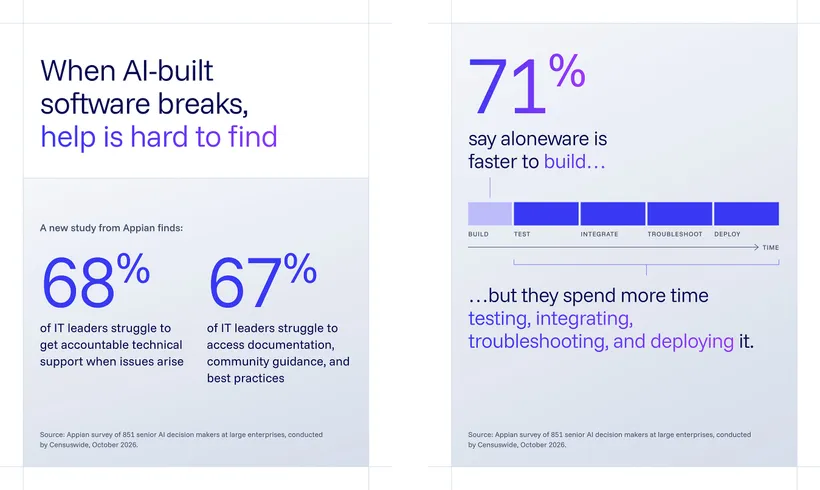
Appian has released research examining the cost of AI-assisted software development among 200 UK decision-makers and IT leaders at large enterprises. The company defines aloneware as applications built or modified with AI-assisted development tools outside an approved enterprise platform environment. Some 79% of UK enterprise leaders surveyed allocate at least 10% of current technology innovation funds to test, deploy, maintain, update, integrate and/or repair isolated AI software builds. The research also found that 71% say AI-built software or “aloneware” is faster to build but takes more time to bring it to market.
Upfront Speed Creates Downstream Work
Almost two-thirds (64%) of enterprise leaders surveyed report that, while standalone AI tools accelerate development, they are spending more time across testing, system integration, troubleshooting, scaling, and/or deployment.
Matt Calkins, CEO at Appian, said:
“Some people get so excited about 'free' software that they forget the risks. Enterprises can now create tech debt faster than ever before.”
Innovation Budgets Under Pressure
Almost eight in 10 (79%) enterprise leaders surveyed report allocating at least 10% of their current technology innovation budgets to testing, deploying, maintaining, updating, integrating and/or repairing software built outside a platform environment. Some 43% currently allocate at least 20% of the budget, while 55% expect to allocate that amount within the next two years. Separately, 60% of UK enterprise leaders report unexpected post-launch costs or resources tied directly to security, governance, and compliance remediation.
Support And Platform Needs
The survey found that 60% of leaders find it challenging to access accountable technical support when problems arise with applications built outside a platform, while 61% report difficulties keeping code, architecture, dependencies, and system integrations up to date. A shared architectural foundation would improve respondents’ ability to control total cost of ownership for 59% of those surveyed, while 60% say it would help them maintain software over time.
Matt Calkins, CEO at Appian, said:
“The most important applications in enterprises need support. If you vibe-code them, there will be nobody to turn to when problems occur. Using AI to build applications on a commercial platform combines the speed of AI with the reliability of supported technology.”