Info-Tech Targets Game Day Venue Technology Risk
Info-Tech venue platform operating model blueprint helps sports CIOs clarify ownership, governance and system integration for game-day operations.
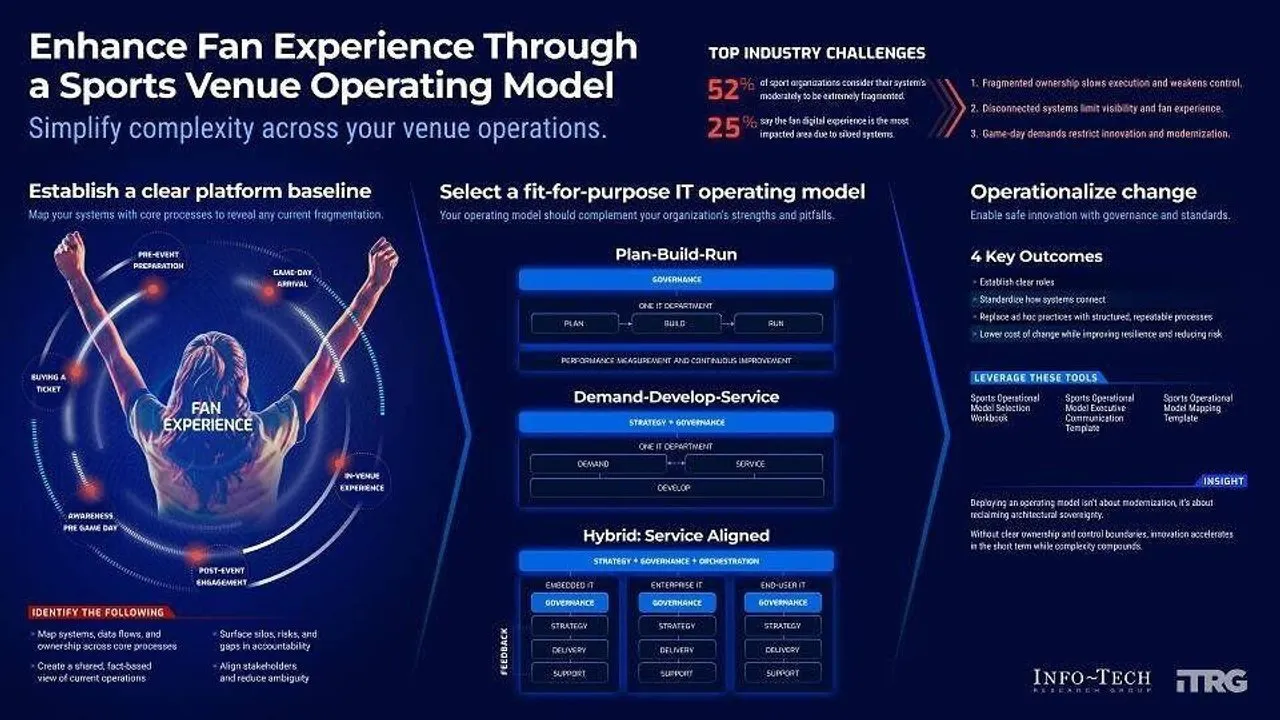
Info-Tech Research Group has published its Build a Venue Platform Operating Model blueprint to help sports CIOs manage the operational risks created when critical venue systems are owned by different entities. The advisory firm’s framework addresses technology spanning ticketing, mobile applications, access control, point-of-sale systems, sponsorship platforms and fan data. It sets out a three-phase process to map systems and data, select an operating model, and define governance. The resource also includes a selection tool covering seven operating model archetypes, a mapping template and an executive communication template.
Fragmented Ownership Creates Risk
Sports organisations must deliver a connected fan experience even where teams, venues, leagues, vendors and partners control different elements of the technology estate. Info-Tech identifies fragmented ownership, disconnected systems and data, and near-zero tolerance for downtime as the principal barriers to more cohesive venue operations.
The firm argues that unclear decision rights can turn technology changes into cross-entity negotiations, while point-to-point integrations and inconsistent data ownership add cost and fragility. Game-day disruption can also make organisations reluctant to modernise critical systems, extending reliance on legacy technology and associated technical debt.
Michael Adams, Senior Research Analyst at Info-Tech Research Group, said:
“CIOs are accountable for the experience fans have, even when they do not control every system behind it. That gap between accountability and authority is where delays, inconsistent decisions, and operational fragility take hold. Technology integration can connect the systems. A venue operating model determines who owns the fan relationship, who governs the data, and who has authority to act when a game-day issue demands an immediate decision.”
Three Phases For Venue Governance
The blueprint begins with mapping systems and data across the fan journey, identifying who controls and operates each capability, and documenting gaps around disconnected data, ownership and integrations. It then directs leaders to develop design principles based on their ownership structure, game-day requirements, integration needs and strategic objectives.
In its final phase, the methodology focuses on defining platform governance roles, assigning decision rights and accountability, clarifying capability ownership, and preparing executive communications on the proposed changes and outcomes.
Michael Adams, Senior Research Analyst at Info-Tech Research Group, said:
“A strong venue platform can preserve local flexibility while making shared responsibilities explicit. Certain capabilities need consistent standards across the enterprise, while others can remain closer to the team or venue. Clear boundaries allow innovation to move forward without relying on informal coordination or compromising game-day reliability.”
A Clearer Operating Model
Info-Tech’s supporting resources are designed to help leaders assess seven operating model archetypes against their organisation’s design principles and document present and future ownership. The firm positions the approach as a practical route to clearer accountability and better coordination across systems and partners, supporting connected fan experiences and coordinated venue operations.