Astrogate Targets 2027 OISL Flight Readiness
Astrogate optical inter-satellite link terminal targets 2027 flight readiness after the company unveiled its OISL capability at BSX 2026.
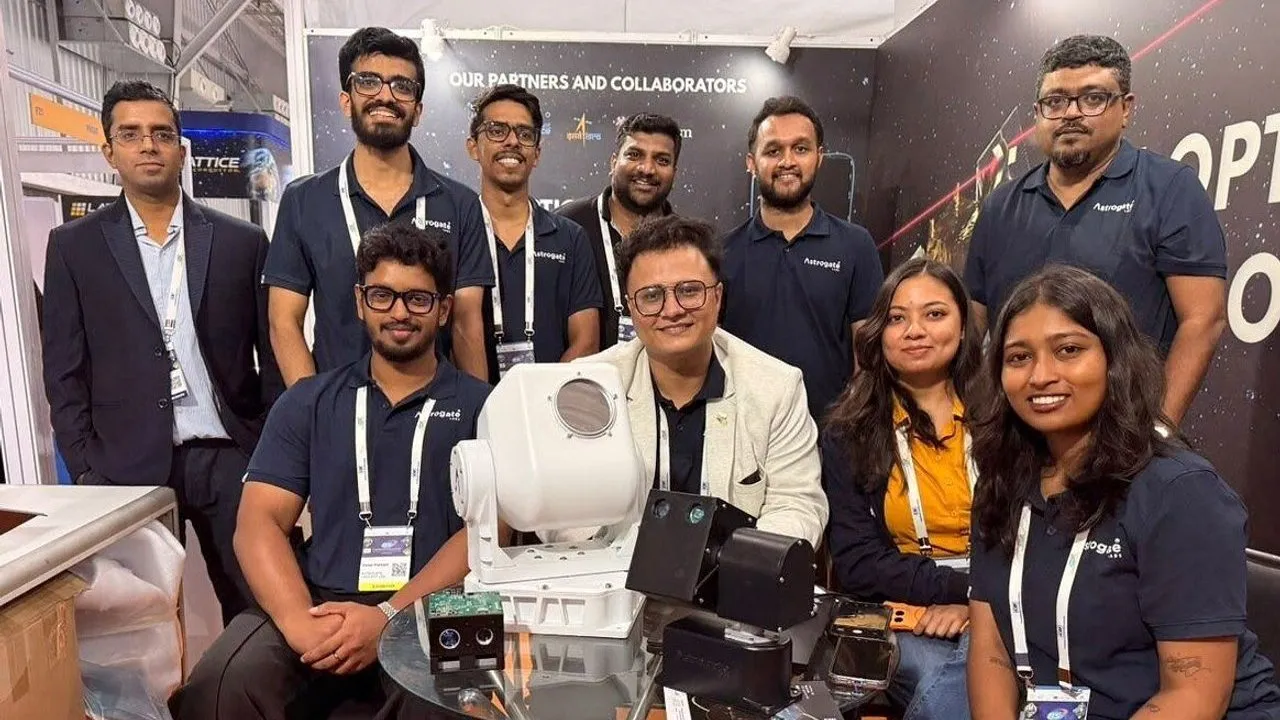
Astrogate Labs has unveiled its Optical Inter-Satellite Link capability at Bengaluru Space Expo 2026, with flight readiness for India’s first indigenous OISL terminal targeted for 2027. The Indian deep-tech company also demonstrated AstroLink Micro, a 10 Gbps space-to-ground laser communication terminal, at the event. Its space-to-ground terminals have reached Technology Readiness Level 8, while the company has already supplied an indigenously developed satellite-to-ground laser communication terminal to ISRO. The development positions Astrogate to extend its optical communications portfolio from links between satellites and Earth to direct satellite-to-satellite connectivity.
From Ground Links To Orbit
Astrogate’s space-to-ground laser communication terminals are complete and qualified for flight. The company has also completed cross-compatibility testing with the University of Western Australia’s TeraNet mobile optical ground station, confirming interoperability with international ground infrastructure.
The OISL capability and AstroLink Micro demonstration were presented at Bengaluru Space Expo 2026, held from 7 to 9 September at BIEC. Astrogate is targeting satellite backhaul, sovereign defence constellations and orbital compute with its inter-satellite terminal.
Nitish K. Singh, Founder & CEO at Astrogate Labs, said:
“Some time back, laser communication from India was a research question. Today it is a product we deliver, with ISRO as a customer. OISL is the harder problem, and it is the one that decides who builds the connectivity layer for future LEO constellations. We are building it, with technology owned end to end in India,”
Optical Layer For Constellations
Optical inter-satellite links allow satellites to communicate directly, moving data through a constellation before routing it to Earth. Astrogate’s technology is designed for satellite networks where conventional RF links face spectrum and bandwidth constraints as data volumes increase.
Optical communications use highly directional laser beams for secure, high-bandwidth and low-latency connectivity. The architecture has been demonstrated at scale by SpaceX, whose 2025 Starlink progress report describes more than 13,000 bidirectional laser links operating as an optical mesh in orbit.
Jayaraman Yogeshwaran, Co-Founder & CTO at Astrogate Labs, said:
“The core building blocks of our OISL terminal - the Pointing, Acquisition and Tracking (PAT) system, the optical modem, stabilized coarse tracking gimbals and system-level integration - were developed and validated for Astrogate's space-to-ground terminals, and carry over to inter-satellite links. That inheritance is what puts flight readiness within reach by 2027,”
Indigenous Communications Capability
Headquartered in Bengaluru, with an office in Durham, England, Astrogate Labs designs and manufactures Free Space Optical Communication terminals for space and other high-performance communication applications. Its systems integrate proprietary Pointing, Acquisition and Tracking technology, optical modems and other in-house developed subsystems.
With validation from end users including ISRO and the University of Western Australia’s TeraNet mobile optical ground station, the company is building on its flight-qualified space-to-ground work as it develops an indigenous optical connectivity option for satellite constellations.