PMET Collects 2.5 Tonnes for Caesium Testwork
PMET caesium sampling programme has collected more than 2.5 tonnes of pollucite pegmatite for CV13 ore sorting testwork.
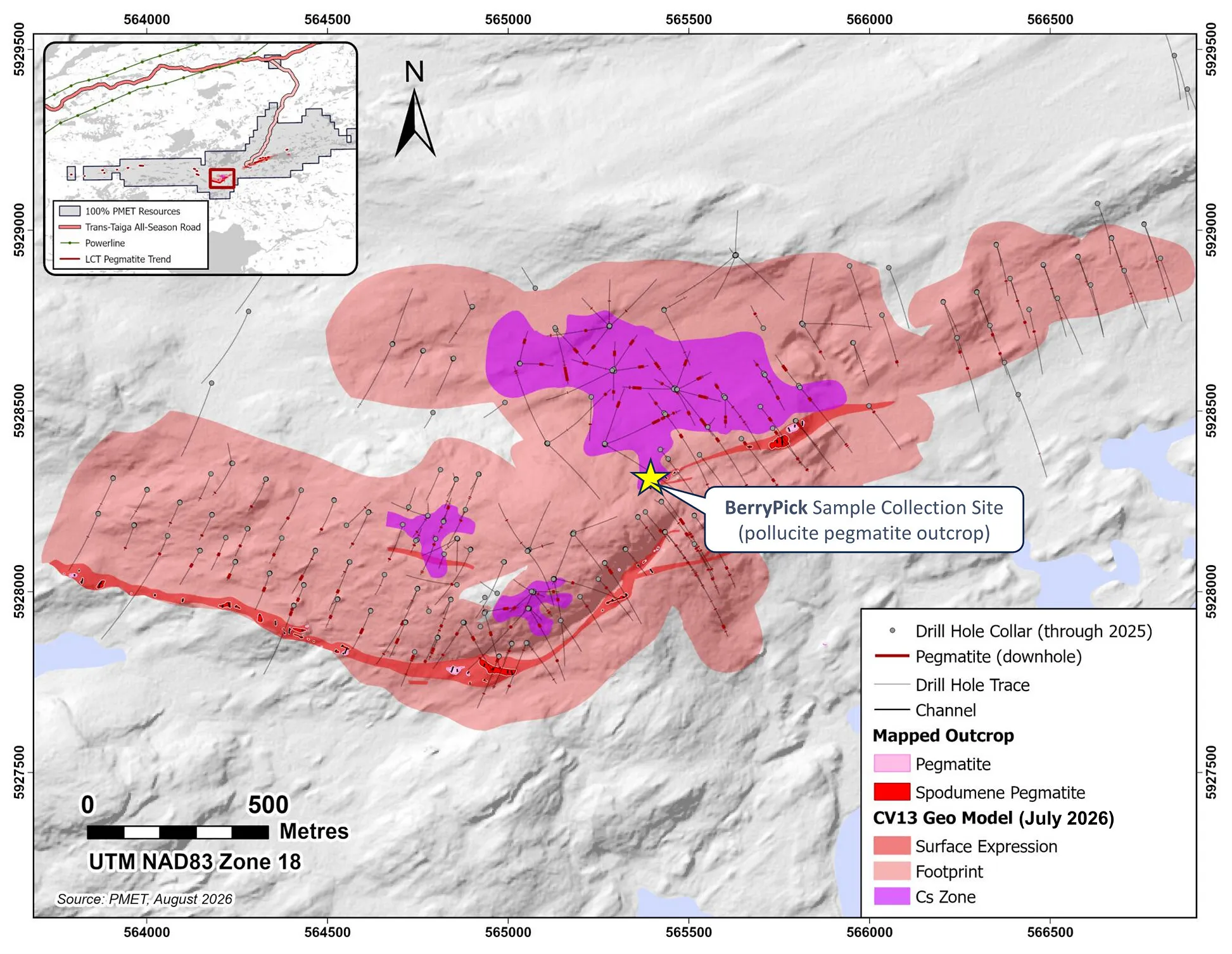
PMET Resources Inc. has collected more than 2.5 tonnes of pollucite pegmatite from the Vega Caesium Zone at its CV13 Pegmatite, advancing its BerryPick programme for concentrate recovery and downstream caesium chemical testwork. The company is using shallow, large-diameter drilling of about 30 cm to collect material from mineralised outcrop. PMET aims to produce 500 kg to 1,000 kg of pollucite concentrate for development studies and potential future chemical testwork. Ore sorting testwork is anticipated to begin in the fourth quarter of 2026, with results expected in the first half of 2027.
Large Scale Sample Collection
The sampling programme targets an outcrop at the Vega Caesium Zone within CV13, where previous channel sampling returned 3.0 m at 9.43% Cs2O, reported by PMET on April 9, 2025.
PMET is recovering approximately 30 cm diameter core from a grid of shallow holes, each less than 60 cm deep. The larger fragments are intended to better approximate blasted run-of-mine material after crushing than the NQ and HQ core sizes used in prior testwork.
The company stated that the approach offers a lower-cost alternative to methods such as blasting or PQ coring when collecting sufficiently large fragments for more advanced test programmes. Collected core will be composited for ore sorting and geochemical analysis, while final composite grades will be released alongside the test results.
Concentrate And Chemical Studies
The BerryPick samples are intended to support feasibility-level assessment of recovery behaviour and generate representative pollucite concentrate for downstream work. PMET plans to continue collecting samples through the autumn, as practical.
The company is also continuing engagement with downstream caesium industry participants, including Koch Technology Solutions, with potential future chemical testwork envisaged as part of the relationship. PMET previously reported on July 12, 2026 that it had demonstrated more than 97% caesium extraction from pollucite concentrate.
CV13 Caesium Resource
CV13 hosts what PMET describes as the world’s largest in-situ pollucite-hosted caesium pegmatite Mineral Resource, comprising 0.69 Mt at 4.40% Cs2O in the Indicated category and 1.70 Mt at 2.40% Cs2O in the Inferred category. The CV13 Pegmatite lies less than 3 km along trend from CV5, which is situated about 13 km south of the Trans-Taiga Road and powerline infrastructure corridor.
PMET’s technical information relating to the Mineral Resource Estimate, exploration and metallurgical results was reviewed and approved by Darren L. Smith, M.Sc., P.Geo., the company’s Executive and Vice President of Exploration. The company noted that visual mineral abundance estimates are not substitutes for laboratory analysis and may not indicate impurities or physical properties relevant to valuation.
Next Steps At Shaakichiuwaanaan
The sampling campaign marks a practical next stage in PMET’s effort to build a larger body of material for caesium processing studies at its wholly owned Shaakichiuwaanaan Property in Quebec’s Eeyou Istchee James Bay region. By combining bulk sample collection, ore sorting and downstream testwork, the programme is designed to inform the company’s assessment of pollucite concentrate production from the Vega Zone.