Founder Burnout Is an Operational Risk. Put It on the Risk Register.
Founder burnout belongs on that list, and not as a wellness topic.
Every company I have worked with keeps a risk register. It lists the things that could stop the business: a key customer leaving, a supplier failing, a ransomware attack, a cash crunch. Each risk has an owner, early-warning signs and a plan. Almost none of those registers mention the founder's capacity to keep making good decisions, even though in a young company nearly every other process runs through that one person.
Founder burnout belongs on that list, and not as a wellness topic. It is an operational risk with early-warning signs you can see in the business before anyone says a word about how they feel.
Why the risk stays hidden
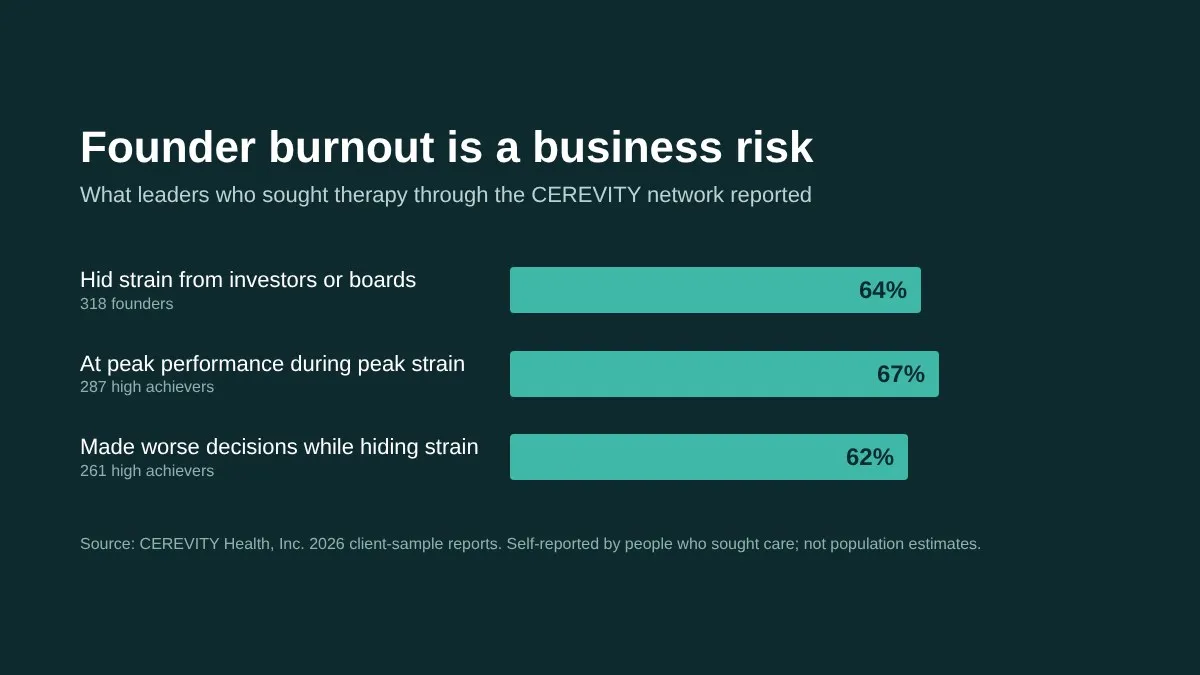
The first problem is that founders hide strain, and they hide it from exactly the people whose job is to manage risk. In a 2026 CEREVITY report, 64% of Founders Conceal Mental Health Strain from Investors, 64 percent of 318 founders and venture-backed operators who sought therapy through the CEREVITY network said they had actively concealed strain from investors or boards, most often for fear of funding or professional consequences. That is a self-reported figure from people who eventually asked for help, so it describes founders who reached care, not every founder. But it points to a governance gap: the risk exists, and the reporting line is switched off.
The second problem is that strain rarely looks like failure at first. In another CEREVITY review, of 287 high achievers who sought therapy through the network, 67 percent said they were performing at their peak during their period of peak strain. Output stays high while the reserves run down. A third review, of 261 high achievers, found that 62 percent made worse decisions while hiding strain. The numbers on the dashboard hold up right until the judgment behind them slips.
Outside research points the same way. In a study of 242 entrepreneurs published in Small Business Economics, Freeman and colleagues (2019) found that 49 percent reported a personal history of one or more mental health conditions, and 30 percent reported depression. And in the National Comorbidity Survey Replication, Mojtabai and colleagues (2011) found that among people who recognized a need for treatment and did not seek it, 72.6 percent said they wanted to handle the problem on their own. For a founder, "I'll handle it myself" is not an excuse. It is the job description, which is why the risk needs a structure around it rather than a reminder to take a day off.
The early-warning signs show up in operations first
You do not need to ask anyone about their mental health to watch this risk. The signals are operational, and most of them are already in your systems.
1. Decision backlog. Approvals that used to take a day now take a week. Count open decisions waiting on the founder every Friday. A rising number over a month is a signal, whatever the explanation.
2. Exception handling creeps up. The founder starts personally fixing things the team used to handle, such as a customer escalation, a vendor dispute or a hiring decision two levels down. Watch for work flowing up instead of down.
3. The calendar has no slack. Back-to-back meetings with no empty block for three or more weeks means there is no time left to think, only to react. Ask an executive assistant or chief of staff to flag it.
4. Reversals and rework. Decisions get made, then unmade. Plans change after the meeting rather than in it. Track how many significant decisions were reversed within 30 days.
5. Communication narrows. Updates to the board or investors get shorter and more upbeat at the same time the operating numbers get noisier. Thin reporting is often the first visible form of concealment.
None of these proves anything about one person's health. That is the point. They are business signals, and a business can respond to them without asking anyone to disclose a diagnosis.
Three practical examples
A software company with 40 staff noticed that its founder had 23 open approvals in the shared tracker, up from about eight a quarter earlier. Instead of asking the founder whether he was all right, the chief operating officer proposed a decision-rights matrix: spending under a set amount, routine hires and standard contract terms moved to department heads. The backlog fell within a month, and the founder got back about six hours a week.
A services firm noticed that its founder was taking every difficult client call personally. The fix was a rotation: three senior staff took turns as the escalation owner each week, with the founder as the final step only when a contract was at risk. That one change took the founder out of the after-hours loop most weeks.
A venture-backed startup added a standing item to its board agenda called "key-person capacity." Each quarter the board reviewed coverage for the founder's critical responsibilities, who could step in for each one, and whether the founder had taken real time away. Nobody was asked about their health. The board was asking about continuity, which is its job.
These examples are composites drawn from common situations, not named companies, but each step is something a manager could start on Monday.
How to build the risk into your register
1. Name the risk plainly. Write "Founder or CEO capacity" as a line item, with likelihood, impact and an owner other than the founder, such as the COO or the board chair.
2. Map single points of failure. List every decision, relationship and system login only the founder holds. Each one needs a named backup and a written handover note.
3. Set measurable triggers. Choose two or three of the signals above, for example open approvals over 15 or no full day off in eight weeks, and agree in advance what happens when one is hit.
4. Plan the cover before you need it. Decide who runs the weekly leadership meeting, signs payments and speaks to key customers if the founder is away for two weeks. Test it with a real, planned absence.
5. Separate capacity from confession. Boards and investors can ask whether responsibilities are covered and whether the leader has room to think, without asking anyone to disclose a condition. Put that principle in writing.
6. Make confidential help easy to reach. Founders who fear funding consequences will not use a route that runs through the company or the board. Give them one that does not: a benefit they can book from their own phone, paid in a way that does not show who used it.
What boards and investors can do
Investors already price key-person risk into deals. Few of them do anything to reduce it after the money is wired. A short written policy can change that: the company funds confidential care for its leaders, the board will never ask who used it, and the board will judge performance on agreed responsibilities rather than on whether someone took time away. A founder who gets help in month two is a smaller risk than one who arrives in month twenty-one after a near miss.
The bottom line
Founder burnout is not a private matter that happens to affect the business. It is a business risk that happens to sit inside a person. Treat it the way you treat cash and cybersecurity: name it, give it an owner, watch the early signals and build the backup before you need it.
Sources
1. CEREVITY Health, Inc., 64% of Founders Conceal Mental Health Strain from Investors (2026): review of 318 founders and venture-backed operators who sought therapy through the CEREVITY network.
2. CEREVITY Health, Inc., 67% of High-Achievers Peak During Peak Strain (2026): review of 287 high achievers who sought therapy through the CEREVITY network.
3. CEREVITY Health, Inc., 62% of High-Achievers Make Worse Decisions While Hiding Strain (2026): review of 261 high achievers who sought therapy through the CEREVITY network.
4. Freeman, M. A., Staudenmaier, P. J., Zisser, M. R. and Andresen, L. A. (2019). The prevalence and co-occurrence of psychiatric conditions among entrepreneurs and their families. Small Business Economics, 53, 323 to 342.
5. Mojtabai, R. and colleagues (2011). Barriers to mental health treatment: results from the National Comorbidity Survey Replication. Psychological Medicine, 41(8), 1751 to 1761.
Disclosure: the author is a co-founder of CEREVITY, a private-pay therapy network.
Elijah Fernandez, MSW, PMP, CISSP, is co-founder and CTO of CEREVITY Health, Inc., a private-pay concierge network of independent licensed clinicians built for high achievers: executives, founders, physicians, attorneys and finance leaders. He spent about 20 years in healthcare IT, including as director of IT operations at a national mental health company, and writes about risk, privacy and leadership capacity. Find out more at cerevity.com.