Chief Operating Officer vs President: Who Does What
Chief operating officer vs president: who reports to whom, why firms merge the titles, and how SpaceX, Amazon, United and Goldman Sachs set them up.
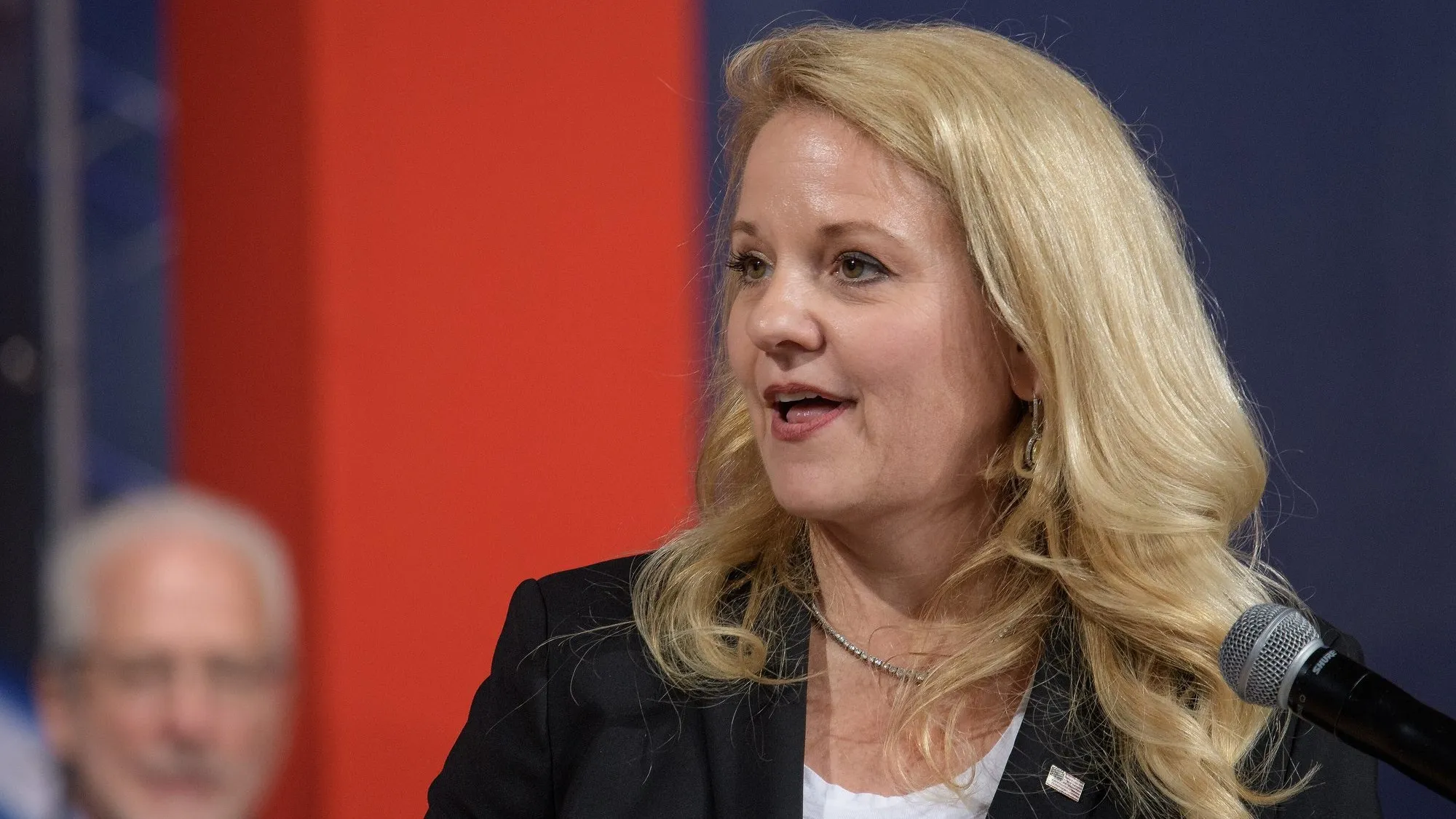
Gwynne Shotwell, president and chief operating officer of SpaceX, speaking at NASA's Johnson Space Center in Houston on 3 August 2018. Photo: NASA/Bill Ingalls, Public domain, via Wikimedia Commons.
A chief operating officer (COO) runs a company's day-to-day operations and usually reports to the chief executive. A president has no fixed job: in some companies the president is the chief executive, in others the president is the number two, and at many firms one person holds both titles as "president and COO".
So the honest answer to "which is higher?" is that it depends on the company. The table sets out the usual pattern in US corporations.
| Chief operating officer | President | |
|---|---|---|
| Reports to | The chief executive | The board if the president is also CEO; otherwise the CEO |
| Focus | Running the business day to day: operations, staff, processes, delivery | Varies: the whole company, or the set of functions the board and CEO hand over |
| Typical background | Long experience in the industry the company works in | Varies widely: operations, business development, banking, finance or law |
| Who appoints them | The board of directors | The board of directors |
| Often combined with | President ("president and COO") | Chief executive ("president and CEO") or COO |
| UK equivalent | Chief operating officer or operations director | Rarely used; the chief executive or managing director runs the company |
What a chief operating officer does
The COO is the senior executive in charge of the company's daily administrative and operational work. Investopedia's definition puts it plainly: the COO "typically reports directly to the chief executive officer (CEO) and is considered second in the chain of command". The chief executive sets the plan; the COO makes it happen.
Many large companies do without one. In 2025, 38.1% of the 664 Fortune 500 and S&P 500 companies tracked by the executive search firm Crist|Kolder Associates had a COO, with 256 sitting COOs between them. The average from 2015 to 2025 was 35.5%. For a fuller look at the job itself, read what a chief operating officer does.
What a president does
"President" is an old corporate title with no single meaning. US law leaves officer titles to each company. Delaware's General Corporation Law says every corporation shall have "such officers with such titles and duties as shall be stated in the bylaws or in a resolution of the board of directors". So the president's job is whatever the board says it is.
In practice there are three common uses. The president is the chief executive under another name. Or the president is the CEO's deputy across the whole business. Or the president title sits with the COO, so one person runs operations with the rank of number two.
Who reports to whom
The COO reports to the chief executive. The president reports to the board when the president is also the CEO, and to the CEO in every other case. When a company has both a president and a COO as separate people, each company draws its own chart.
The board appoints both. United Airlines' annual report states that its "executive officers are elected by UAL's Board" and "serve at the discretion of the Board", which is the normal US position.
How five big companies set it up
| Company | Chief executive | President | Chief operating officer | Set-up |
|---|---|---|---|---|
| SpaceX | Elon Musk | Gwynne Shotwell | Gwynne Shotwell | President and COO in one person |
| Goldman Sachs | David Solomon | John Waldron | John Waldron | President and COO in one person |
| Amazon | Andy Jassy | Andy Jassy | None listed | CEO holds the president title |
| United Airlines | Scott Kirby | Brett Hart | Toby Enqvist | Separate president and COO |
| Microsoft | Satya Nadella | Brad Smith | None listed | President who is neither CEO nor COO |
President and COO: SpaceX and Goldman Sachs
Gwynne Shotwell has been SpaceX's president and chief operating officer since 2008 and a board member since March 2009, according to the company's 2026 share offer documents. She joined in 2002 as vice president of business development. Elon Musk is founder, chief executive, chief technical officer and chairman. Musk keeps the top job and the engineering lead. Shotwell holds the operating role.
Goldman Sachs uses the same model. John Waldron has been president and chief operating officer since October 2018. His boss, David Solomon, held the same pair of titles from January 2017 before becoming chief executive in October 2018.
CEO who is also president: Amazon
Amazon lists Andy Jassy as "President and Chief Executive Officer", a post he has held since July 2021. Jeff Bezos held the president title for most of the years from 1994 to 2021, then passed both titles to Jassy and became executive chair. Amazon's list of executive officers has no COO. The heads of Amazon Web Services and Worldwide Amazon Stores each carry the title CEO of their part of the business instead.
Separate president and COO: United Airlines
United splits the jobs three ways. Scott Kirby has been chief executive since May 2020. Brett Hart has been president since May 2020, after years as the airline's general counsel and chief administrative officer. Toby Enqvist has been executive vice president and chief operations officer since July 2022, and before that was chief customer officer. Both men are listed as executive officers, separate from the chief executive.
A president who is neither CEO nor COO: Microsoft
Microsoft shows how far the title can stretch. Brad Smith has been vice chair and president since September 2021. Before that he was the company's general counsel. Satya Nadella is chairman and chief executive, and Microsoft's latest annual report lists no COO among its executive officers.
Why some companies combine the two titles
Putting "president" on the COO's door tells staff, customers and investors who the clear number two is. It also marks a likely successor. Investopedia's list of COO types includes "the heir apparent", who learns from the CEO "in order to ultimately assume the CEO position".
The figures fit. In the Crist|Kolder 2025 report, 43.9% of sitting chief executives at Fortune 500 and S&P 500 companies came straight from a COO or president role, the largest single source. Solomon at Goldman Sachs is one example. At United, Kirby was president from August 2016 to May 2020 before becoming CEO. Ed Bastian at Delta Air Lines was president from 2007 until he became chief executive in May 2016. For the career path, see how to become a chief operating officer.
How the titles work in UK companies
In the UK, "president" is seldom an executive title. The person who runs the company is the chief executive or the managing director. The UK Corporate Governance Code 2024 names the chair and the chief executive as the two top roles and does not use the word president at all.
The Code's Provision 9 says: "The roles of chair and chief executive should not be exercised by the same individual." The Financial Reporting Council's guidance describes the chief executive as "the most senior executive director", responsible for "proposing company strategy and for delivering the strategy as agreed by the board". That is a sharp contrast with Microsoft and Goldman Sachs, where the chief executive is also chairman.
The managing director title is written into UK company law's model rules. Table A, the standard regulations for the management of a company limited by shares under the Companies Act 1985, lets the directors "appoint one or more of their number to the office of managing director or to any other executive office".
Which does a business need?
A founder who wants to keep the vision and the outside work, and hand over the running of the place, needs a COO. If that person is also the clear successor, giving them the president title as well makes the line of command plain. A company that needs a senior leader across the whole business, separate from day-to-day operations, can follow United and name a president alongside a COO. Whatever the titles, writing down who decides what matters more than the words on the door. More on senior roles is in our Leadership section.
Sources
- SEC: SpaceX free writing prospectus, June 2026
- SEC: SpaceX Form 10-Q for the quarter ended 30 June 2026
- SEC: Goldman Sachs 2025 Form 10-K
- SEC: Amazon 2025 Form 10-K
- Amazon Investor Relations: Andy Jassy
- SEC: United Airlines Holdings 2025 Form 10-K
- SEC: Microsoft Form 10-K for fiscal year 2026
- SEC: Delta Air Lines 2025 Form 10-K
- Crist|Kolder Associates: Volatility Report 2025
- Investopedia: What Does a Chief Operating Officer (COO) Do?
- Delaware Code: Title 8, Section 142, Officers
- Financial Reporting Council: UK Corporate Governance Code 2024
- Financial Reporting Council: Corporate Governance Code Guidance
- legislation.gov.uk: Companies (Tables A to F) Regulations 1985, Table A



.jpg)