Supermicro and Nokia Deploy AI RAN at Network Edge
Supermicro and Nokia are deploying AI-RAN systems with NVIDIA technology to support low-latency AI services at the network edge.
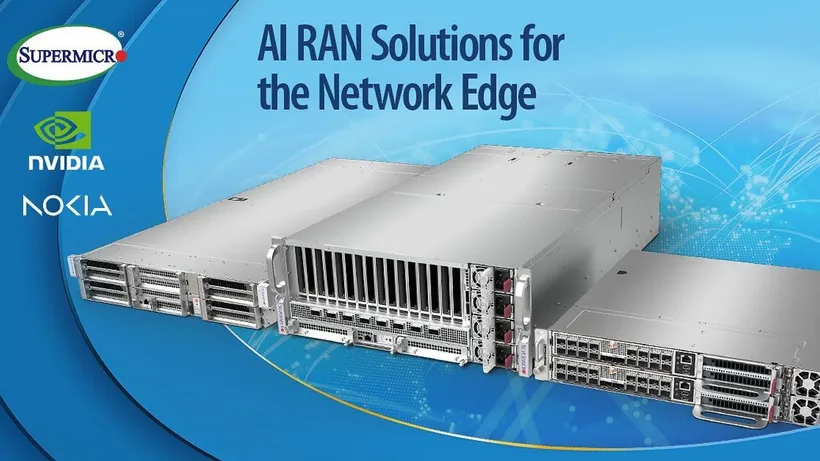
Supermicro is working with Nokia to deploy AI-RAN systems from distributed cell sites to centralised network hubs. The companies are combining Nokia RAN software with NVIDIA Aerial RAN Computer technology and Supermicro’s AI-optimised infrastructure. The modular portfolio includes systems delivering up to 1.6 PFLOPS of FP4 AI performance, alongside 2U and 4U configurations for edge, aggregation and core locations. The deployment is intended to support low-latency AI services, enterprise edge inferencing and physical AI applications.
Shared Network Infrastructure
The platform is designed to allow radio and AI workloads to run on shared infrastructure, supporting voice AI, vision AI, physical AI and autonomous network operations. Supermicro’s Data Center Building Block Solutions® approach is intended to give operators a software-upgradeable route towards AI-native 6G networks.
Charles Liang, president and CEO, Supermicro, said:
“AI-RAN is redefining networks for AI, turning mobile infrastructure into a shared foundation for connectivity, AI for RAN, AI on RAN, and broader distributed AI services. Together with Nokia and NVIDIA, we are bringing accelerated computing to every layer of the network, enabling operators to maximize infrastructure efficiency, deploy new AI services, and prepare for AI-native 6G. Our DCBBS approach delivers the flexibility and performance to accelerate deployment and turn network infrastructure into a platform for innovation.”
Systems Across The Network
For distributed cell sites, the ARC MGX 2U Short-depth platform brings inference closer to radios, users and applications. Supermicro’s dual-node ARC-Pro combines an NVIDIA Grace C1 CPU and NVIDIA RTX PRO 4500 Blackwell Server Edition GPU per node in a 429 mm chassis, while the ARC-Compact provides a 1U short-depth option for network functions.
At centralised MSO and aggregation sites, the ARC MGX 2U supports coordinated inference through dual NVIDIA Vera CPUs or dual x86 processors and two NVIDIA RTX PRO 6000 Blackwell Server Edition GPUs. Core network hubs can use the ARC MGX 4U, which supports up to eight NVIDIA RTX PRO 6000 Blackwell Server Edition GPUs, dual x86 CPUs and up to 6 TB of DDR5 memory.
Emma Falck, President of Mobile Infrastructure at Nokia, said:
“AI-RAN represents an important step towards more intelligent and adaptable mobile networks. By combining Nokia's leadership in radio networks with NVIDIA accelerated computing and Supermicro's flexible infrastructure, we are giving operators a practical way to bring RAN and AI workloads together across their networks. This will help operators improve network performance and automation today while creating a foundation for new edge AI services and AI-native 6G.”
Availability And Deployment
Supermicro’s servers for NVIDIA ARC are generally available now. The ARC MGX 2U with dual Vera processor is on display at NVIDIA GTC Berlin from 20 to 22 October 2026 and will be available later this year. The 2U ARC-Pro is planned for customer testing later this year, followed by general availability in the first half of 2027.
Soma Velayutham, VP of Telecoms, NVIDIA, said:
“AI-RAN brings together networking, accelerated computing, and intelligence to help operators make better use of their infrastructure while opening new opportunities for edge AI services. Nokia and Supermicro are helping operators deploy NVIDIA Aerial RAN Computer solutions across diverse network environments, from distributed cell sites to centralized RAN locations, with the flexibility to scale intelligence capabilities as demand grows.”